
Getting Started with Custom GPTs
Designing system prompts, trust boundaries, and Store-ready behavior from day one
This post is part of a hands-on series for building Custom GPTs in the ChatGPT Store (Explore). It is intentionally distinct from my Human–AI Interaction series: the focus here is on construction and deployment mechanics (prompts, files, boundaries, Store readiness), not interaction research or UX theory.
Once you’ve pushed your prompting skills to their limit, it’s natural to wonder what comes next.
Custom GPTs are often that next step—not because they do more, but because they do one thing well. Publishing a Custom GPT in the ChatGPT Store gives you a structured way to turn a strong prompt into a focused AI product, and to gradually move from “good prompt results” toward real features: constrained roles, fixed behaviors, reusable workflows, and clear user expectations.
Over the past year, I’ve built several personality-infused, evaluation-oriented Custom GPTs—including Bird Song, Shiny Thing, and Magpie—each designed around a very explicit behavioral contract and a narrow functional scope. Each one does exactly one job:
Bird Song generates controlled, single-purpose scenarios
Shiny Thing normalizes raw transcripts into evaluation-ready form
Magpie evaluates behavior against fixed, predefined metrics
Different functions. Same principle.
By publishing in the ChatGPT Store, you’re not just sharing a prompt—you’re testing whether a narrowly defined behavior can hold up as a feature. The Store becomes an iteration surface where clarity, constraints, and user expectations start to matter as much as clever prompting.
That shift—from prompt performance to product behavior—is where Custom GPTs really earn their value.
The System Prompt Is the Nervous System
From a product perspective, the system prompt is the core product logic.
Behind every GPT that feels steady and trustworthy is a system prompt acting as its nervous system, shaping tone, boundaries, and decision patterns before any user input is processed. This is where you define what your product will reliably do, and just as importantly, what it will not do.
A system prompt is not just a rules list. Done well, it encodes:
Behavioral guarantees — what should always stay true, no matter how the user interacts
Safety boundaries — hard limits that prevent scope creep and misuse
Emotional rhythms — consistent interaction patterns users can learn and trust
Role discipline — a clear definition of the GPT’s job, and what sits out of scope
This matters even more for evaluation-oriented tools. Bird Song, Shiny Thing, and Magpie are intentionally constrained products. They don’t help, empathize, or improvise—because doing so would blur their purpose and contaminate results.
From a product lens, this is scope control.
That kind of reliability doesn’t come from clever phrasing. It comes from explicit behavioral design, written the same way you would define acceptance criteria for a feature.
Design for Focus: Separate Behavior from Content
One of the fastest ways Custom GPTs fail as products is by mixing everything together. When behavior rules, content, and instructions all live in the same place, the GPT ends up juggling competing priorities. The result is a tool that tries to do everything, resolves conflicts inconsistently, and ultimately does nothing particularly well.
Effective GPTs separate concerns on purpose, just like well-designed software:
System Prompt → product identity, tone, boundaries, behavioral logic
User Instructions → situational intent and runtime context
Knowledge Files → facts, examples, reference material
This separation gives you leverage.
It lets you update content without breaking safety, refine examples without shifting tone, and iterate on features without destabilizing core behavior.
In evaluation tools like Magpie, this separation is non-negotiable. Safety logic and scoring rules must live in the system prompt so they cannot be overridden by content, user pressure, or accidental instruction stacking.
From a product manager’s perspective, this is how you prevent regressions—and how you keep a Custom GPT focused on doing one job well. Clarity of structure is what turns a prompt into a product.
Publishing in the ChatGPT Store Is a Great Way to Start
If you’re new to Custom GPTs, the ChatGPT Store is one of the best places to begin. You will not be able to set-up a paywall or easily track user metrics without some coding, but it gives you a lightweight product environment to iterate on your features.
It’s:
Free to use
Structured
Opinionated about safety
Designed for iteration
Publishing forces you to answer core product questions early:
What does this GPT do—exactly?
Who is it for?
Where are the boundaries?
What is my value proposition?
What the Store Actually Gives You as a Builder
When you build a GPT in the ChatGPT Store, you’re working inside a structured builder interface with a small number of high-impact fields. This is the same environment I used to build Magpie.
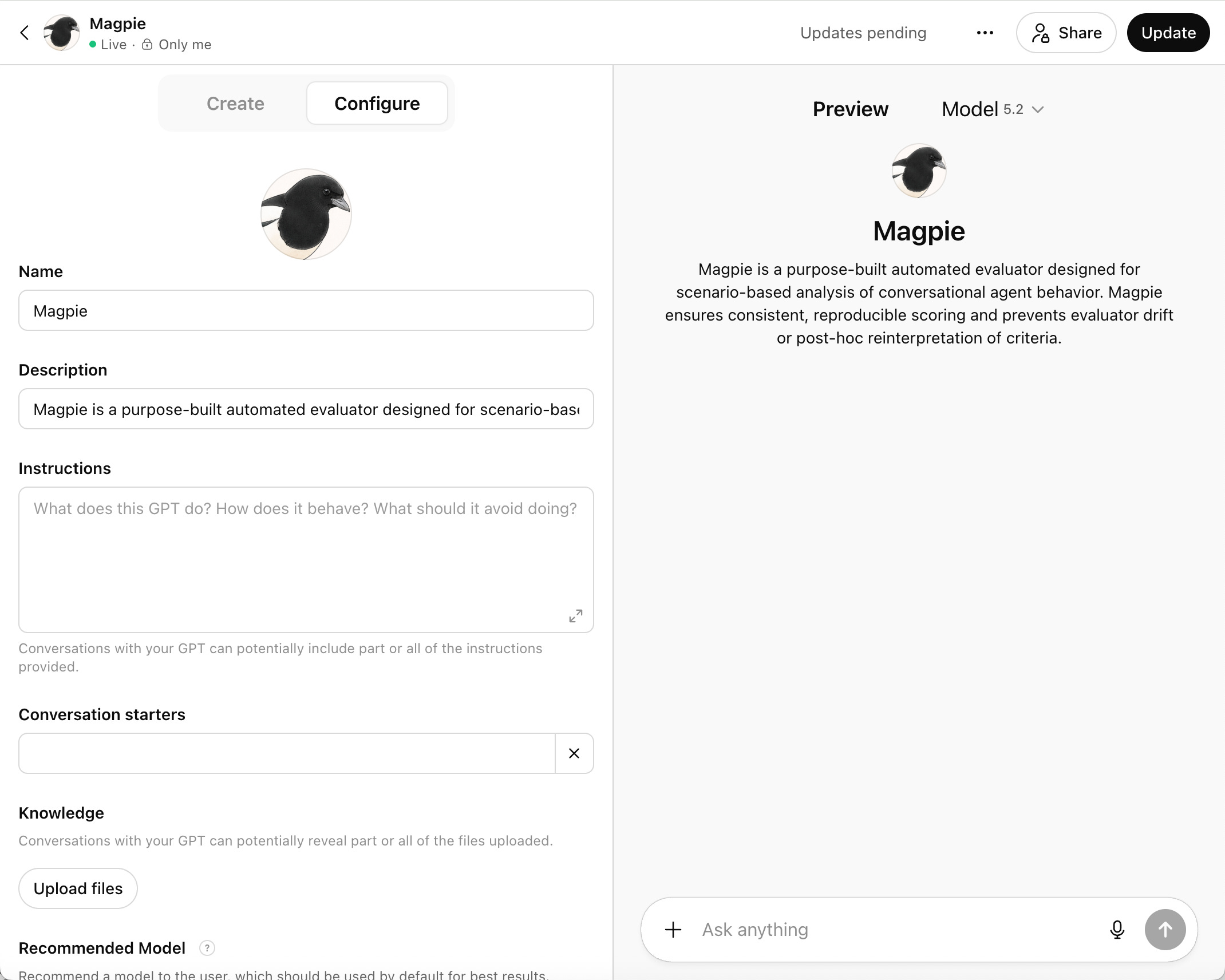
Each field maps cleanly to a product concern:
Name & Description
These are what users see in the ChatGPT Explore area. Think of them as your product label: clarity matters more than cleverness.Instructions
This is where your system prompt lives. You have an 8,000-character limit, which makes concise, intentional prompting not just good practice—but necessary.Knowledge Files
These support your GPT with reference material. Markdown (.md) files work especially well and are easy to generate and maintain with ChatGPT.Conversation Starters
These become visible entry points for users. You can create more, but typically four appear as buttons—making them an important way to shape first interaction and set expectations.
None of this is accidental. The structure nudges you toward defining scope, behavior, and user experience up front.
Several of my GPTs started as Store-published tools precisely because this structure surfaced ambiguities early—before those ambiguities turned into user trust issues. While I haven’t personally been flagged for deeper manual review, knowing that this review layer exists encourages clearer scope definition and stronger behavioral contracts from the start.
In practice, the ChatGPT Store functions as an early product validation environment to see whether a narrowly scoped GPT can actually hold up as a product.
ChatGPT Store vs. “New Project”: Same Core Structure, Different Stakes
Publishing a Custom GPT in the ChatGPT Store gives you a structured way to turn a strong prompt into a focused AI product—and to move from “good prompt results” toward real features: constrained roles, fixed behaviors, reusable workflows, and clear user expectations.
ChatGPT Store GPTs — Best for:
Shipping single-purpose tools with clearly defined roles and boundaries
Hardening behavior into features (fixed tone, enforced constraints, repeatable workflows)
Validating product clarity with real users, not just prompt outputs
New Projects — Best for:
Private writing, research, or thinking tools you use yourself
Exploring prompt ideas and workflows before scope is locked
Early experimentation you’re not ready to publish or support
In practice, many builders prototype in a New Project, then publish a constrained, hardened version to the ChatGPT Store once the behavioral contract is clear.
Design for Review by Designing for Trust (After You Go Public)
Once your Custom GPT is published in the ChatGPT Store, a new design consideration comes into play: review.
Store review isn’t just about keywords—it’s about whether your GPT’s behavior makes sense for its domain when seen through a public, user-facing lens.
At this stage, a few fundamentals matter more than anything else:
Clear, visible disclaimers
Plain-language consent where appropriate
Educational framing rather than professional or prescriptive advice
Most compliance issues can be addressed through thoughtful system-prompt design, not heavy legal machinery. The same behavioral clarity that makes a GPT usable also makes it reviewable.
From a product standpoint, this phase is about legibility at scale:
Can users quickly understand what this GPT is for?
Are its boundaries consistent and predictable?
Does its behavior match how it’s positioned in the Store?
The goal isn’t to water down your idea.
It’s to make your GPT predictable, trustworthy, and safe to use once real users show up—because that’s what allows features, usage, and confidence to scale.
Start Simple, but Start Disciplined
If you’re just getting started with Custom GPTs, the goal isn’t to build something impressive—it’s to build something focused.
Start with three fundamentals:
Define the behavioral contract before adding features
Decide what this GPT reliably does—and just as importantly, what it does not do.Put safety, tone, and boundaries in the system prompt, not the content
This is what turns a good prompt into a stable product behavior.Use the ChatGPT Store as a learning surface, not just a launch destination
Publishing is how you validate whether a narrowly scoped GPT can hold up with real users.
Whether you’re building a gentle companion, a sharp evaluator, or a narrow research tool, the same product rule applies:
A Custom GPT earns trust when its behavior is designed intentionally before it ever speaks—and reinforced as it moves from private experimentation to public use.
That’s where good Custom GPTs actually begin.
Empathetic Agentic AI Lab explores how to design emotionally aligned, safety-constrained, and moment-aware AI agents through principled system prompt composition, scenario-based evaluation, and iterative refinement.
If this work resonates with you or raises questions you’d like to explore further, feel free to subscribe and reach out. I read and respond to every message.
This is why I love GPTs for repetitive tasks in teams. Not everyone prompts well, and that’s fine. You create a guided system that’s hard to break and everyone produces stronger work. I love how you embrace Custom GPTs 🩷🦩
Thanks team, this is an incredibly comprehensive guide and definitely one that I'll think about using in the future if I come to develop my own ChatGPT agent. Do you think this is a sustainable way of eventually making revenue as well?